Why now

Your AI strategy is only as strong as the capacity of the people directing it

Leadership, longevity, and the future of work are converging on one constraint: the Biological Capacity behind consequential decisions.

Book an Executive Briefing
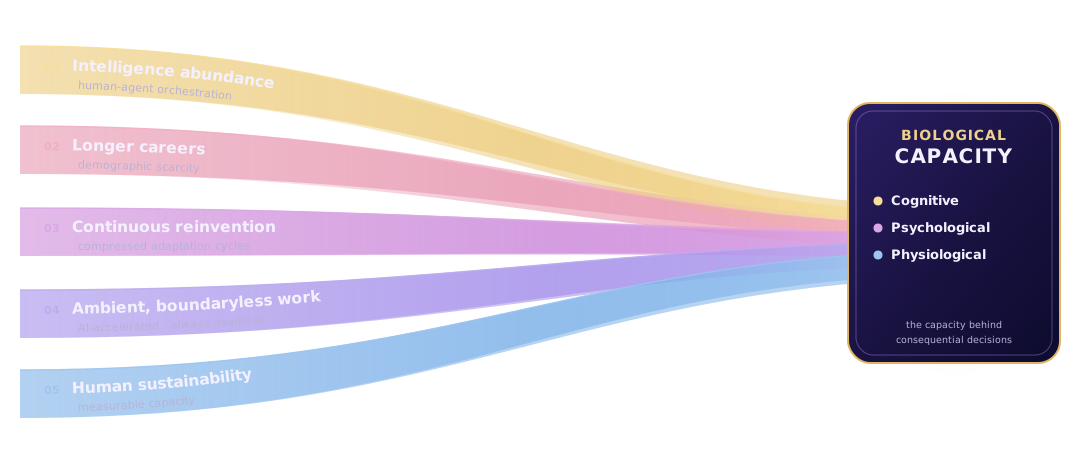
Five structural forces converging on the cognitive, psychological, and physiological dimensions of Biological Capacity

The conditions of leadership have changed

Organizations have built systems to scale technology, information, productivity, and growth. They have invested far less in understanding whether the people directing those systems can sustain the judgment, adaptability, and recovery the strategy requires.

01

Systems are scaling

Technology, information, productivity, and output can expand faster than the people responsible for directing them.

02

Critical judgment remains finite

Attention, adaptation, regulation, and recovery still depend on the capacity available to the responsible leaders.

03

The exposure is converging

Five structural forces are increasing the load on the same cognitive, psychological, and physiological system.

Work redesign is rising faster than workforce readiness

Mercer's 2026 global survey found a sharp difference between the value executives place on redesigning work for AI and their confidence in current human-machine capability.

63%

of executives said redesigning work to incorporate AI and automation was the people initiative most likely to drive the greatest return.

32%

believed their workforce could optimally combine human and machine capabilities.

This is not simply a technology gap. It is also a work-design, leadership, and human-capacity challenge.

Source: Mercer Global Talent Trends 2026. Executive perceptions, not measured returns or workforce capability.

Five forces changing what leadership requires

Each force changes a different part of the operating environment. Together, they increase dependence on the capacity of the people carrying the most consequential work.

01

Intelligence abundance

& human-agent orchestration

AI is moving beyond assistance towards digital labor: agents that can plan, act, coordinate, and produce work across increasingly complex workflows.

Question for the leadership team

Where will human judgment remain decisive, and do the people accountable for it have the capacity to exercise it consistently?

Read the full force

The limiting question is therefore shifting. It is no longer only, “What can the technology do?” It is also:

  • What should be delegated?
  • What must be independently verified?
  • When must a human intervene?
  • Who owns the decision when work is produced by a mixed human-agent system?

Why it is urgent

As the cost of producing analysis, recommendations, and content falls, the volume of material requiring human direction may rise. Leaders can gain extraordinary leverage, but they can also become the verification, exception-handling, decision-making, and accountability bottleneck.

AI readiness therefore depends on more than technology, skills, and governance policies. It also depends on whether the responsible leaders have sufficient attention, discernment, and decision capacity when human judgment is most needed.

02

Longer careers

& demographic scarcity

Working lives are extending while aging populations, succession gaps, and shortages of critical expertise are making experienced leadership harder to replace.

Question for the board

How much of the organization’s future still depends on the capacity of a few experienced people, and what protects that capacity?

Read the full force

At the same time, organizations increasingly depend on a relatively small number of people who hold deep institutional knowledge, trusted relationships, pattern recognition, and contextual judgment.

This is Experience Capital: the experience-based asset that compounds across a career.

Why it is urgent

Succession plans typically map roles, skills, and potential replacements. They rarely examine whether the leaders the strategy still depends on can sustain the cognitive, psychological, and physiological capacity required to keep applying their Experience Capital.

A leader may remain in position while becoming less able to absorb complexity, recover from sustained demand, or consistently access the depth of judgment the organization assumes is still available.

03

Continuous reinvention

& compressed adaptation cycles

Roles, technologies, skills, and operating models are changing faster than traditional planning, training, and transformation cycles can accommodate.

Question for strategy leaders

Is the organization struggling to change, or are the same critical leaders becoming the bottleneck for every change?

Read the full force

Many organizations begin the next transformation before the previous one has been fully integrated.

Why it is urgent

Adaptability is no longer an occasional capability activated during a defined period of change. It has become a continuous demand on attention, learning, emotional regulation, and recovery.

The same senior people are often expected to run the current business, interpret emerging threats, sponsor transformation, make investment decisions, and maintain confidence across the organization, all at once.

What appears to be resistance, slow execution, or a skills problem may partly be an adaptation-capacity problem concentrated among the people carrying the most consequential work.

04

Ambient, boundaryless work

AI-accelerated, always available

Work is becoming less tied to a specific place, device, schedule, or deliberate request.

Question for the executive team

Has technology reduced unnecessary work, or simply filled the recovered space with more decisions?

Read the full force

Global teams, constant communication, context-aware systems, and AI-enabled workflows can keep activity moving around the clock. Work increasingly arrives pre-emptively: summarized, recommended, escalated, or waiting for approval.

Why it is urgent

These systems can remove friction and administrative burden. But they can also increase throughput, multiply decisions, and eliminate the natural stopping points that once limited work.

This matters because availability is not the same as capacity. A leader may still be online, responsive, and outwardly productive while making decisions at a predictable low point in attention, regulation, or recovery.

When the work never clearly stops, the organization can consume the capacity behind judgment without recognizing that it is doing so.

05

Human sustainability

& measurable capacity

Sleep, stress, recovery, functional capacity, and health risk are becoming more observable through wearables, digital biomarkers, health data, and prevention science.

Question for the organization

As human capacity becomes more measurable, will you govern it deliberately, or allow fragmented tools and practices to define the rules by default?

Read the full force

Information that was previously fragmented or invisible can increasingly reveal how well a person is recovering, functioning, and sustaining performance over time.

Why it is urgent

This creates an opportunity to identify changes earlier, personalize support, and make work design more responsive to human capacity.

It also creates difficult leadership and governance questions:

  • What should an organization measure?
  • What remains private?
  • Who owns and interprets the data?
  • What can legitimately inform work design or support?
  • How can useful insight be separated from surveillance, discrimination or false precision?

Many senior leaders already have doctors, coaches, wearables, and personal health data. Organizations already have performance systems, succession plans, and workforce data. What is usually missing is a responsible way to connect these domains without crossing ethical boundaries.

Five forces. One increasingly visible constraint

What each force adds

  • AI expands available intelligence and output.
  • Demographic scarcity extends dependence on experienced leaders.
  • Continuous reinvention raises the adaptation load.
  • Ambient work can increase decision density and threaten recovery.
  • Measurement makes changes in human capacity harder to ignore.

What organizations see instead

  • Decision overload as a time-management problem
  • Executive strain as a personal problem
  • Succession as a role-replacement problem
  • AI readiness and implementation as a technology and skills problem
  • Longevity as a benefits or private-health problem
Does the organization have the leadership capacity required to execute the future it is designing?

Make the exposure discussable before it becomes a performance problem

Bio-Optimized Leadership™ gives boards and executive teams a shared management view of the capacity behind consequential decisions. A 60–90 minute Executive Briefing helps the senior team identify:

Leadership Capacity Exposure MapA visual preview connecting strategic pressures, biological capacity signals, business exposure, and three first moves.LEADERSHIP CAPACITY EXPOSURE MAPWhere capacity may constrain the decisionPRESSURES IN VIEWDecision loadKey-person relianceAI and transition demandLATENT CONSTRUCTBiological CapacityThe capacity available to do the workSignals reviewed across cognitive,psychological, and physiological capacityEXPOSURE MADE VISIBLEDecision qualityAbsorption capacityContinuity and executionTHE FIRST THREE MOVES01ProtectWhat cannot be allowed to degrade02MeasureWhat evidence would change the decision03ChangeWhat to test, govern, or redesign first
01

Where leadership-capacity exposure may be concentrated

02

Which decisions, roles or strategic priorities are most dependent on a few people

03

What can be examined without collecting personal health data

04

Which three actions are worth considering next

05

Whether further measurement, work-design change or a governed pilot is warranted

Your strategy already depends on Biological Capacity

The Executive Briefing examines business exposure and management questions. It does not diagnose leaders or require biometric data.