The Leadership Capacity Self-Assessment©
Score Your Leadership Team's Biological Capacity In Five Minutes
A 5-minute self-assessment for executives responsible for other leaders. Answer 10 questions, score yourself against the band key, and get a personalized read on where your exposure sits. Educational self-screen, not a diagnosis.
In this brief (5 minutes): ① the five forces putting leadership capacity on the board agenda → ② the model, in one picture → ③ your 10-question self-assessment, with a guide to reading your score. The aim is awareness: see the exposure first. What to do about it comes after.
Start the Self-AssessmentWhy this, why now
The One Input Underneath Every High-Stakes Call
Your organization measures almost everything that drives performance - pipeline, burn, engagement, AI adoption, .... It does not measure the one input underneath every high-stakes call your senior people make: Their biological capacity to think clearly, decide well, and sustain both under pressure.
Biological Capacity integrates the cognitive, psychological, and physiological capacity available on the day of the decision. Relevant functions can be examined, but no single measure captures the whole construct. When capacity changes, the first signal may be a change in attention, regulation, recovery, or sustainable effort rather than illness.
This is where longevity, healthspan, and the future of work meet the boardroom. As the workforce ages and AI reshapes how decisions get made, protecting the domain-specific functions on which demanding leadership depends becomes a strategic question, not a health footnote. Whether BOL interventions extend Peakspan remains a hypothesis to be tested.
The context
5 Forces Putting This on the Board Agenda Now
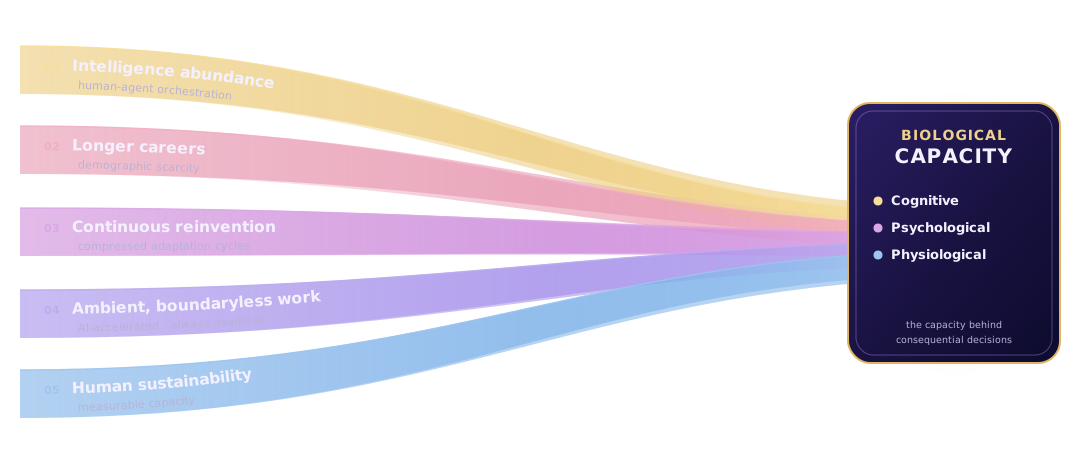
Three things the chart understates. Early research raises questions about AI use, cognitive offloading, and active thinking. Gerlich (2025) is observational; Kosmyna et al. (2025) is a small, task-specific EEG preprint. A separate methodological critique is also a preprint. Neither establishes generalized cognitive decline from AI use. Mercer's global 2026 survey found that 62% of employees believe leaders underestimate AI's negative emotional and psychological impact, while only 19% of HR leaders say their digital implementation strategy considers it. And 80% of 400 business leaders surveyed for Mercer's 2025 Executive Outlook said their organization could do more to mitigate aging-workforce risk. Both Mercer findings are self-reported views, not measured capacity or performance effects.
The organizations that navigate the next decade well won't ask their leaders to simply work harder. They will test whether responsibly governed capacity evidence adds useful leading information beyond existing health, talent, and performance data.
The framework
The Model Behind the Questions
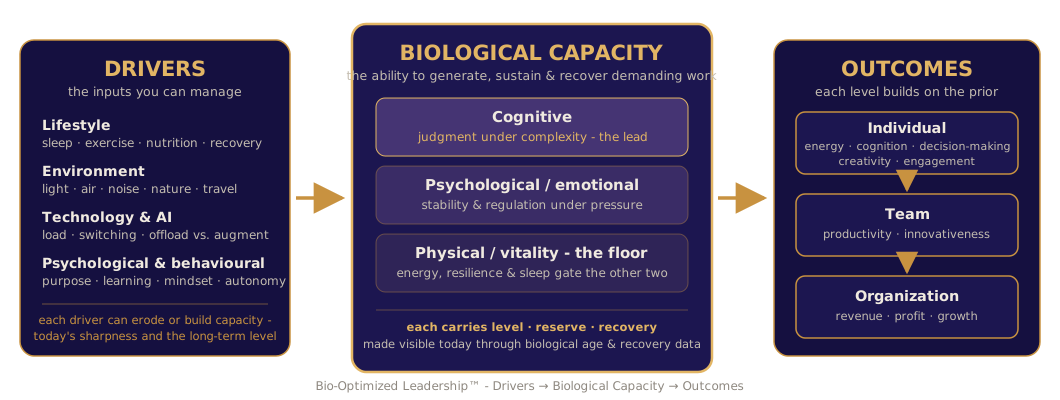
Bio-Optimized Leadership™ connects three things most organizations treat as unrelated.
Drivers - your lifestyle, environment, technology and AI use, and psychology - build or drain your Biological Capacity: the integrated Cognitive, Psychological, and Physiological Capacity available for demanding work. The three dimensions are distinct for analysis and interdependent in the whole person.
That capacity may influence Outcomes directly and through decision, behavioral, relational, role, team, and organizational pathways. Inference becomes less direct at each downstream level.
Each dimension is examined through Level, Reserve, and Recovery. Level is available capacity under defined conditions. Reserve and Recovery normally require challenge-based or repeated observation. No single wearable signal, biological-age clock, or composite score measures the whole construct.
One more thing the model makes clear: a leader's experience can keep accumulating across a career. BOL proposes that applying it may depend partly on Biological Capacity. Experience Capital is what experience builds; Biological Capacity is what lets a leader use it. The interaction remains a testable hypothesis.
The self-assessment below reads this model right to left - starting where your board already lives: Results.
The 10 questions: public, verbatim
The 10-Question Self-Assessment
Score each statement: 2 = Yes, clearly true · 1 = Partly / not sure · 0 = No.
The band key: public
Reading your Score (0–20)
16–20
Capacity-Aware
You're ahead of nearly every organization. The value now is sharpening the edge and defending it as you scale.
10–15
Exposed
You have real, nameable blind spots in your top team's capacity, the kind that stay invisible until they cost you a decision.
0–9
Unmeasured Risk
Your most expensive decisions are running on an unmonitored system. This is the highest-leverage gap on this page.
FAQ
Before You Start
Figures above are population-level findings from the cited research, not guarantees, and this self-assessment is an educational self-screen - not a medical or diagnostic instrument.
Dr. Ines O'Donovan, PhD (Management Learning & Leadership), MBA - creator of Bio-Optimized Leadership™, Stanford AI+Longevity Futurist, and founder of the first women's longevity magazine. ~15 years in longevity science; originator of a research framework examining Biological Capacity as a modifiable input to leadership performance and downstream outcomes.